What to Study Before Taking Your Provincial Driving Test
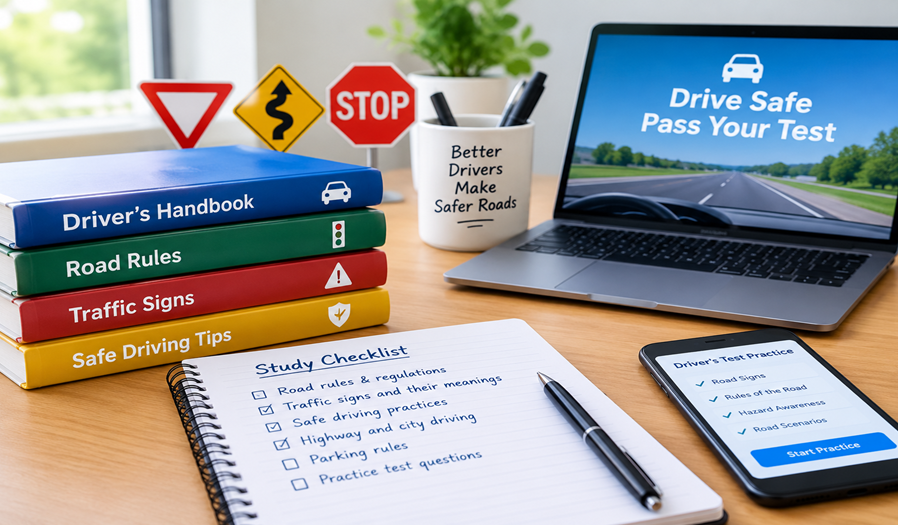
A provincial driving test is easier to prepare for when you know exactly what you are being assessed on. The biggest mistake learners make is treating the test as a memorisation exercise. You need to understand the rules well enough to recognise how they apply to different traffic situations, signs, intersections and road conditions.
Because Canadian licensing requirements vary by province and territory, your preparation should begin with the official driver’s handbook for your jurisdiction. Practice resources such as Drivingtest.ca can then help you test your knowledge and identify areas that need more work.
Start With Your Provincial Driver’s Handbook
Canada does not have one standard driving test for the entire country. Each province and territory has its own licensing authority, handbook, testing process and, in some cases, graduated licensing requirements.
Before studying, make sure you are using the current handbook for the province where you will take your test. Do not rely on notes or practice material designed for another province without checking the applicable rules.
Pay particular attention to sections covering:
- Traffic signs and signals
- Right-of-way rules
- Speed limits
- Intersections and turning
- Lane changes and passing
- Parking and stopping
- Pedestrian and cyclist safety
- School and playground zones
- Emergency vehicles
- Impaired driving
- Seat belt requirements
- Graduated licence restrictions
The handbook is the foundation of your preparation because practice questions are ultimately testing knowledge of these rules.
Learn Road Signs by Meaning
Road signs are easier to remember when you understand what they require you to do.
Start with common regulatory signs, including stop, yield, speed-limit, no-entry and parking-related signs. Then study warning signs that identify hazards such as sharp curves, intersections, pedestrian crossings or changing road conditions.
Read More: Data-backed coaching turns remote work patterns into clearer results
Do not stop at recognising the sign. Ask yourself what action a driver should take when approaching it.
For example, seeing a yield sign should immediately make you think about slowing down, checking surrounding traffic and yielding as required. This approach is more useful than memorising the sign’s name alone.
Also review pavement markings, traffic lights and lane-control signals. A test question may describe a situation rather than simply display a sign.
Focus on Right-of-Way Rules
Right-of-way is one of the areas where memorisation can quickly fail you. You need to understand how priority works in different situations.
Study what happens at:
- Controlled and uncontrolled intersections
- Four-way stops
- Stop signs and yield signs
- Left and right turns
- Pedestrian crossings
- Roundabouts
- Intersections involving cyclists
- Roads where lanes merge
- Situations involving emergency vehicles
When studying a scenario, identify who is approaching, who is turning, who has stopped, and what traffic controls are present. Then determine who must yield.
This method prepares you for differently worded questions instead of teaching you to recognise one familiar answer.
Know the Rules for Sharing the Road
A provincial driving test is not only about what you do behind the wheel. You also need to understand how your vehicle interacts with other road users.
Review the rules and safe practices involving pedestrians, cyclists, motorcycles, buses and large commercial vehicles.
Understand why cyclists may require additional space, why trucks have larger blind spots and how drivers should respond around pedestrians. Pay attention to situations involving school buses and emergency vehicles as well.
Read More: Turning Knowledge into Action: How Students Can Apply What They Learn
These topics are particularly useful because they test whether you can recognise potential hazards before they become immediate problems.
Study Speed, Stopping and Safe Following
Knowing a posted speed limit is only part of understanding speed management.
Review the difference between the posted maximum speed and driving at a speed appropriate for current conditions. Weather, visibility, traffic, road surfaces and congestion can all affect how safely you can travel.
You should also understand:
- Safe following distances
- Braking and stopping considerations
- Adjusting speed for poor weather
- Maintaining control on slippery roads
- The effect of visibility on driving decisions
- Safe passing and lane-changing practices
Do not assume that driving at the speed limit is automatically appropriate in every situation. Questions may test your judgement rather than your ability to recall a number.
Use Drivingtest.ca to Find Your Weak Areas
Once you have studied the official material, practice tests become much more valuable.
Drivingtest.ca can be used as a practice resource to check how well you understand common driving-test topics. Treat incorrect answers as study signals rather than simply counting how many questions you got right.
If you repeatedly miss questions about intersections, go back to that section of your provincial handbook. If road-sign questions are causing problems, spend more time reviewing signs and pavement markings.
A useful cycle is:
Study → Practice → Review mistakes → Study again → Retest
Do not memorise the correct answer to a practice question without understanding the rule behind it. A real test can present the same concept using completely different wording.
Prepare for Situational Questions
Many learners concentrate heavily on definitions and signs but struggle when they have to apply a rule to a scenario.
When you see a situational question, slow down and identify the facts before looking for an answer.
Ask:
- What traffic control is present?
- Who is moving and who is stopped?
- Is someone turning or changing lanes?
- Are pedestrians or cyclists involved?
- Is there a hazard or unusual road condition?
- Which rule determines the driver’s action?
Be especially careful with words such as “must,” “should,” “before,” “unless” and “when.” A small detail can change the appropriate response.
Avoid Studying Everything Equally
You do not need to spend the same amount of time on every page of the handbook.
Start with the topics you find difficult and the rules that involve actual decision-making. Road signs, right-of-way, intersections, parking, speed management and sharing the road deserve focused attention.
At the same time, do not ignore less familiar sections simply because practice questions seem easier. The actual provincial driving test may cover areas you have not encountered repeatedly in practice.
The goal is broad understanding with extra preparation in your weak areas.
What to Review Before Test Day
In the final study session, avoid trying to learn the entire handbook from scratch. Review your notes, difficult signs, frequently missed questions and rules that you previously misunderstood.
Take one or two practice tests under realistic conditions. Do not use notes or look up answers while completing them.
Most importantly, verify practical test-day requirements with your provincial licensing authority. Required identification, fees, appointment procedures, eligibility rules and test formats can change, so current official information should take priority over older online advice.
Conclusion
Preparing for a provincial driving test is much more effective when you study the rules behind the questions rather than memorising answers. Start with the current provincial handbook, concentrate on signs, right-of-way, intersections, speed management and road-user safety, then use practice tests to expose gaps in your knowledge.
Resources such as Drivingtest.ca can make that practice more structured, but the strongest preparation comes from being able to explain why a particular driving decision is correct. That understanding will help you on the test and, more importantly, when you are actually driving on Canadian roads.